Written by: Hibah Saddal
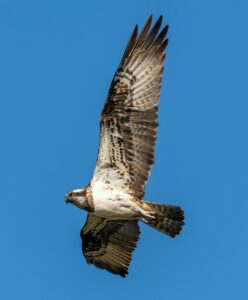
Have you ever watched a bird in flight and noticed how its wings bend and spread out, rather than
remaining rigid like an aeroplanes? This flexibility is one of natures evolved designs. Engineers study
such ideas through something called bio-inspired fluid-structure interaction, learning how living things or designs inspired by them interact with air or water. In our research we investigate how bio-inspired wings interact with airflow during flight.
Birds have amazing wings that can bend and flex during flight. This flexibility helps them stay steady, even when winds are strong or gusty. Unlike rigid wings, bird wings can change shape in response to the air moving around them, or passively adapt.
Engineers are studying how bird wings work to help design flexible or ‘morphing’ wings for small flying vehicles such as drones (also called unmanned aerial vehicles (UAVs)). The goal is to make these vehicles fly more smoothly and efficiently.
Instead of building lots of real wings for testing, engineers often use computer simulations. These simulations create a visual model that shows how flexible wings bend, how they interact with the air, and how the air flows around them. By testing many different wing shapes and material properties on computer simulations, engineers can quickly compare designs and discover which one works best.
Bird wings also consist of many layers of feathers. Some of these feathers, such as the covert feathers and the alula, help birds stay stable during sharp turns or intense winds. Engineers take inspiration from these ideas. For instance, small flexible flaps attached to a wing, similar to a bird’s feathers, can help keep the airflow smoothly attached to the wing. This creates more lift and delays stall at steep flight angles, improving performance. Here, engineers can use computer simulations to test and optimise the size, location, quantity, and materials of these flaps to improve flight performance.
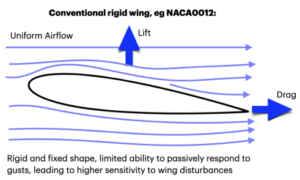
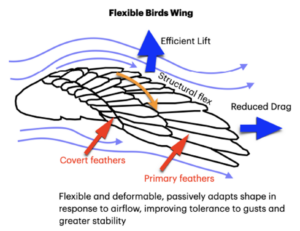
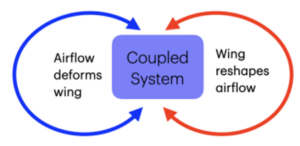
To understand how air moves around a wing during flight, a computer code to model the airflow is used, and another to model how the wing bends, or changes shape, when the air pushes on it. It is important to get this right because the air pushes on the wing, and the wing deforms and reshapes the air, making it move differently, too. The air and the wing affect each other, this is a back-and-fourth interaction between the air (fluid) and the wing (structure), or a fluid-structure interaction.
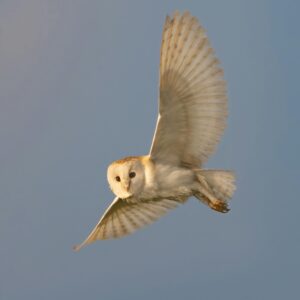
Examples of different wings examined include conventional wings, such as the NACA0012 airfoil, and those based on real birds, such as the peregrine falcon and barn owl.
To adjust how flexible the wings are, we adjust factors like material density and how easily they bend or stretch. In this way, we can replicate different materials. By trying different settings, we can compare stiff wings to bendy wings to see how each behaves in the air and which is more optimal for flight.
Using ideas from bird wings, engineers can design wings that are more efficient, more flexible, and more stable in the air. With computer simulations, young researchers can test multiple ideas instead of building real wings, saving time and money. The knowledge they gain from these tests helps them to create new UAV wings that can change shape in flight, just like birds do, so they can fly better in different conditions.
Share this post