Written by: Madhav Ramesh
You might have heard that your internet is being ‘upgraded to fibre optic’, but what does this actually mean, and how can those fibres connect you to the internet? They are made of glass after all…
What is an optical fibre?
Optical fibres are cylindrical glass fibres (like a thread made of glass) with two essential layers, and protective layers as required. The two important layers are called the ‘core’ and the ‘cladding’. For standard telecommunications fibres, the cladding is silica, a common type of glass, and the core of the fibre is the same, but ‘doped’ with Germanium. Doping is when you add small amounts of something else (e.g. germanium) to improve the properties. The dopant changes the refractive index of the core (linked to the speed at which light travels through the glass) to allow light to travel down the optical fibre through a process called ‘total internal reflection’. This phenomenon keeps the light bouncing between the boundary of the core and cladding, instead of leaking out the side of the fibre. Essentially, the light is retained within the fibre, it cannot escape from the sides, only down the length of the fibre.
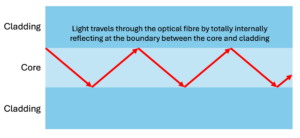
Optical fibres are very small, with a cladding of 0.125 mm (around the width of a human hair) and the core being a tenth of that size! Usually, a protective plastic jacket is added to protect the glass fibre, but even then, the overall size is only 0.25 mm. That means that hundreds of optical fibres can be packaged together without taking up much space.
How does that give me access to the internet?
Whilst optical fibres don’t directly give you Wi-Fi, they do connect your home to the internet, at much faster speeds than traditional electric connections. Why is it faster? Well because optical fibres transfer information at the speed of light (through glass) whereas electrical cables are limited by electrical resistance. So, using optical fibres make your connection to the internet much faster, and your router at home converts that information to Wi-Fi that you can access from anywhere in your home.
The simplest way of transferring information (like the internet) using optical fibres, is to use a binary system where light = 1 and no light = 0. Binary systems are used for all computers.
Whilst you wouldn’t understand if someone came up to you and said 10011100, for computers this is the base of their language, and each 1 or 0 is called a ‘bit’. Complex detectors can be used to detect these 1s and 0s (light on or light off) at incredibly high speeds, and home broadband typically receives 1,000,000,000 bits per second!
Optical fibres don’t just connect your home to an internet hub somewhere on your street, they also connect entire continents. Massive undersea cables with lots of protective layers house optical fibres, enabling long distance communication at rapid speeds.

Where do we go from here?
The materials science side of this technology is huge! Apart from telecommunications, optical fibres can be used as sensors, for transport, space, medicine, and nuclear applications, each of which has their own challenges. Making fibres smaller, cheaper, stronger, better at retaining light etc. are all materials-based challenges that need someone like you to come and tackle them!
Share this post