Written by: Aatiqa Alidina
What are NdFeB magnets?
Neodymium-Iron-Boron (NdFeB) magnets are some of the strongest magnets that have ever been produced. Modern technologies such as speakers, MRI machines, wind turbines, and even electric vehicles rely on them!
Why do we need to make stronger magnets?
Magnets have a glaring weakness – heat. If the magnets heat up to a specific temperature, they lose their magnetisation. This is known as the Curie Temperature, and for NdFeB magnets, this is ~310-400 °C. Due to this, the temperature that the magnets can be used is limited to ~ 80-220 °C.
Devices heat up as we use them, and can go over these temperatures, causing damage to the magnets inside them. We can keep the magnets cool by limiting how long we use them for, but in many cases this wouldn’t work. For example, if the magnets in a wind turbine get too hot because it’s been windy all day, it would have to be turned off. That means electricity production must stop until the magnets have cooled down.
To address this, we usually add dysprosium (Dy) or terbium (Tb) to the magnets during production. These heavy rare earth elements (HREs) make our magnets stronger, and able to work at higher temperatures. However, they are extremely expensive because they aren’t mined in the UK.
With this method, we’d need 10% of the magnets’ weight to be made up of HREs for them to be good enough to be used in EVs and wind turbines. This means they’re expensive to manufacture, making green technologies less affordable.
A new technique: Grain Boundary Diffusion
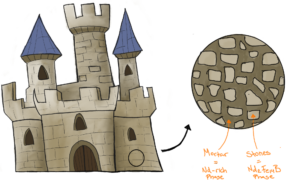
An NdFeB magnet is like a castle; the stones are the magnetic matrix phase which makes up the magnetic material. The mortar is the neodymium-rich grain boundary phase which keeps the stones held together, but makes a barrier between them. To make a strong magnet, we need strong barriers that prevent the stones from influencing each other if one fails (i.e. if a magnetic grain becomes demagnetised, it won’t cause others to do the same).
When Dy or Tb is added before the magnet is made, they spread throughout all the stones in the castle walls. This means we need a lot of it and most of it will go to parts of the castle we don’t need to make stronger.
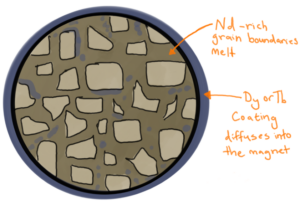
Grain boundary diffusion is a technique that we can use to only reinforce the barriers by making a Dy/Tb shell around them.
This is done in a 4-step process:
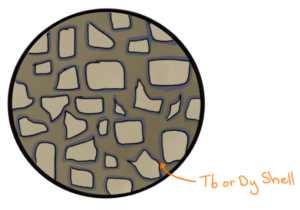
When the painted magnet is heated up, only the grain boundaries (the mortar in the castle) melt, making tiny tunnels. The painted layer travels through the tunnels in a process called diffusion, and forms shells around the stones.
This means that only the barrier gets reinforced, allowing us to reduce the amount of HREs used while still having strong magnets.
Share this post